
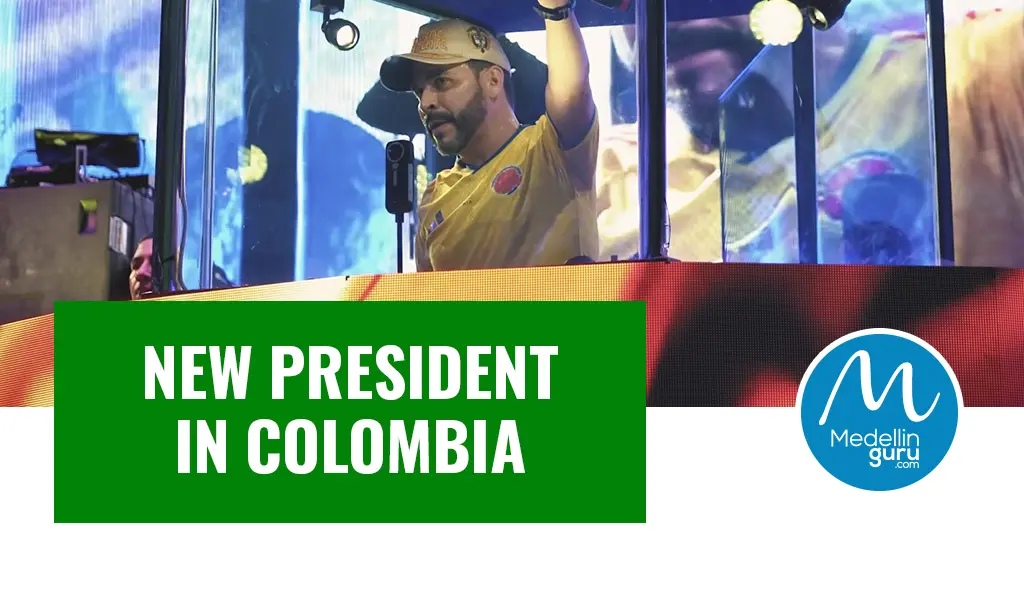
On June 21, Colombia elected Abelardo de la Espriella as its next president, defeating Iván Cepeda in what has become one of the closest votes in our country’s history: 49.66% for the right-wing lawyer versus 48.7% for the left-wing philosopher—less that one percentage point difference between the two contenders for the Casa de Nariño, or just about 250,000 votes.
As a result, this transition has not only Colombians but the entire world on edge. De la Espriella represents a radical shift from many of the current policies, relationships, and priorities of Gustavo Petro’s administration. In fact, this stance defined his campaign: the promise of a significant overhaul in the country’s political, economic, and social agenda.
In this context, it is not just Colombians but also foreigners intending to invest in or migrate to the country in the coming years who have their eyes fixed on his first actions. But what do the government proposals of Colombia’s next president actually mean for expats?
This article aims to analyze and summarize Abelardo de la Espriella’s campaign proposals, as well as their potential impacts on the expat community, while clarifying that it won’t be until the first months of his term that we see the real impact of these promises or the execution of the changes the incoming Colombian president intends to make
Who is Aberlado de la Espriella?
Abelardo Gabriel de la Espriella Otero, born in Bogotá in 1978 and raised in Montería, is a trial lawyer and businessman. A graduate of Sergio Arboleda University with an extensive background in criminal law, he established his public recognition as the founder of a notorious law firm and through his involvement in high-profile media and political court cases nationwide. After shifting his focus to the business sector and opinion activism, he formalized his entry into the electoral arena by founding the civic and political movement “Defensores de la Patria” (Defenders of the Homeland) in 2024.
Prior to his definitive leap into politics, Abelardo de la Espriella’s career in criminal litigation was marked by defending individuals whose cases had massive public, judicial, and media impact in the country. Among his most notable and controversial clients were businessman Álex Saab, internationally designated as a frontman for the Venezuelan government; the cousins Manuel, Miguel, and Guido Nule, the masterminds behind the multimillion-dollar embezzlement scheme known as the “carrusel de la contratación” (contracting carousel) in Bogotá; the former president of Fedegán, Jorge Visbal Martelo, convicted of links to paramilitarism; and the controversial businessman David Murcia Guzmán, founder of the illegal money-snatching scheme DMG. The representation of these complex legal cases consolidated his national image as an aggressive and media-savvy defense attorney—a facet that his detractors frequently contrast with his current platform of strict institutional legality.
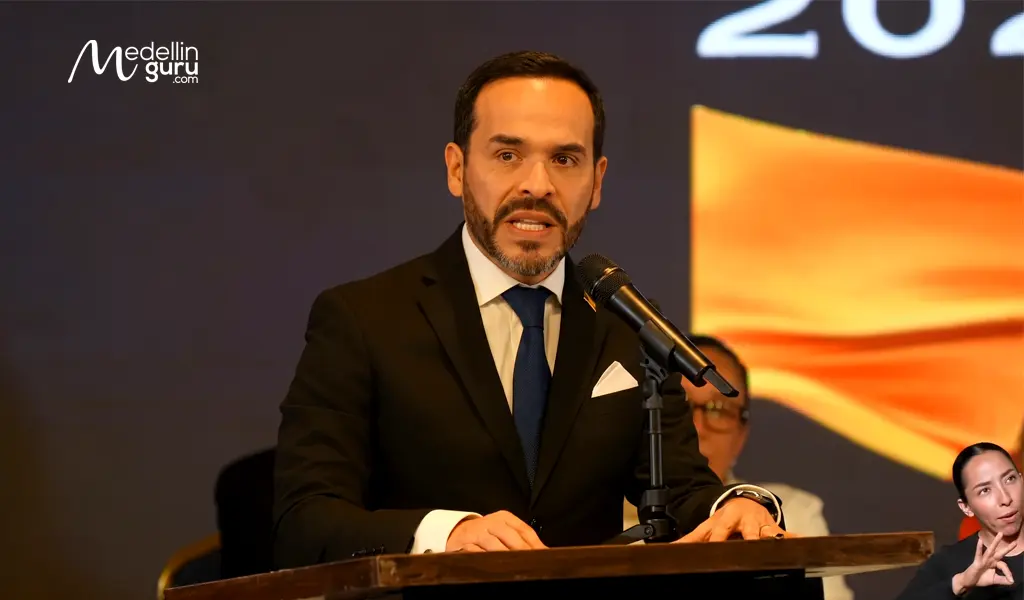
What is the Plan of Abelardo de la Espriella to Increase Investor Confidence?
One of the most important banners of Abelardo de la Espriella’s campaign was his promise to restore investor confidence, both domestically and internationally. Although Colombia’s new president has not detailed many of his plans specifically aimed at attracting foreign capital, he repeatedly asserted that several of his local proposals were also designed to have a global impact, especially to increase investor confidence.
For instance, throughout his campaign, the candidate stood out for his rhetoric promising a “heavy hand” (mano dura) against crime and criminal gangs in the country. De la Espriella promised a 90-day shock plan that will impose clear targets on local authorities to capture or dismantle certain armed groups, as well as apprehend their leaders.
The intent behind these actions is to restore investor confidence by offering greater security guarantees, not only to citizens but also to crucial economic sectors such as agriculture and tourism. The message from the Espriella campaign promises expats looking for investment opportunities in Colombia a landscape where they will be less deterred by issues like violence, extortion, or common crime.
If you are one of the expats who see the potential in Colombia’s next president’s policies to invest in our country, now could be the moment to apply for your Real Estate Investment Visa. Get advice from professionals and save money and time while seizing the opportunity!
The policies of Colombia’s next president to invest in our country, now could be the moment to apply for your Real Estate Investment Visa
Take the First Step and Invest in Colombia
Our reliable partner expatgroup.co offers a wide range of services for Foreign Investors:
What were Abelardo de la Espriella's Proposals on Tax Cuts?
One of the strategies de la Espriella intends to use to improve Colombia’s economy is the elimination and reduction of taxes, particularly those affecting small and medium-sized enterprises (SMEs). The logic behind the measure is to incentivize business growth, with the expectation that it will ultimately be reflected in tax collection redundancy.
For expats, one of the next president’s most critical promises is to eliminate the wealth tax (impuesto sobre el patrimonio). Put simply, this is a tax on accumulated wealth, triggered when a taxpayer’s net worth (defined as total assets minus current debts) reaches or exceeds 72,000 UVT (Tax Value Units), which, for the year 2026, equates to approximately $3.77 billion Colombian pesos (around USD $900,000 at a $3,750 USD exchange rate). This is highly relevant, as it is a contribution that must be paid by both non-resident foreigners and fiscal residents.
The reason behind these measures is that one of the most striking promises of Abelardo de la Espriella’s presidential campaign was a 7% annual growth in Colombia’s Gross Domestic Product (GDP). This figure is no small feat, considering that during Gustavo Petro’s first year in office, GDP growth was 0.7%, and in 2025, it increased by only 2.5%.

Will Abelardo de la Espriella Tighten Immigration Measures?
This is perhaps one of the areas that generates the most confusion among expats. Although Abelardo de la Espriella included tightening and strengthening of immigration laws in Colombia as part of the platform that got him elected, he hinted in interviews that this change would primarily apply to foreigners who enter or remain in the country irregularly. This means that there will be no significant changes regarding the handling of visas or residence permits during his presidency. It is also important to note that in recent years, Migración Colombia and other institutions have increased the requirements for visa applications and established stricter policies regarding irregular expats in our country.
An interesting note lies more in the relationship with Colombian migrants in the United States. The very week of his election, Colombia’s next president met with Representative Bernie Rubio, during which he hinted at accepting the request to receive Colombians who have sought asylum in the U.S. and who, under the new rules of the Trump administration, face deportation.
FAQs About Colombian’s Change of Government
The presidential inauguration took place on August 7 of 2026. From that moment onward, Colombia is under the new administration.
A colombian president is elected for the next 4 years. There have been scenarios where reelection has been instituted as an option (for example, during Álvaro Uribe’s term), but as of the writing of this article, a president cannot be reelected.
He won by less than one percentage point (approximately 250,000 votes), securing 49.66% of the vote compared to 48.7% for his left-wing opponent, Iván Cepeda.
All indications suggest not. De la Espriella has clarified in interviews that the changes and the tightening of immigration laws will apply exclusively to foreigners in an irregular situation. Processes for legal visas or residency will continue as usual.
It proposes eliminating and reducing tax burdens—particularly for small and medium-sized enterprises (SMEs)—to incentivize investment and business growth.
Medellin Guru's safety and security series
Safety is the biggest concern of foreigners visiting Colombia or planning to move to Colombia. So, we have a series of 18 popular articles about safety and security in Colombia:
- Is Medellin Safe? U.S. Embassy Colombia Talks About Security for U.S. Citizens
- Emergency Directory Guides to Ensure Your Safety in Colombia
- Is Colombia Safe? Colombia Security and Safety Tips
- Is Medellín Safe? Medellín Security and Safety Tips
- How to Travel and Live in Colombia Safe as a Foreigner
- Colombia Travel Health Policy: A Guide for Expats and Nomads
- How to Obtain 2 Years of Health Coverage for a Colombian Visa
- Migración Colombia alert: No entry for foreigners with Angel Watch reports
- What are the Safest Neighborhoods in Medellín and the Aburrá Valley
- 5 Best Neighborhoods in Medellín: A Guide to Choosing a Neighborhood
- New Airbnb Policies for Hosts in Colombia
- Medellín Robbery: Expat Experience Being Robbed at Knifepoint
- Colombia Gun Laws: Is it Legal to Have a Gun in Colombia?
- Scopolamine: The Realities of Devil’s Breath in Colombia
- Colombia Protests: Tips for Foreigners to Stay Safe During Protests
- Is Bogotá Safe? Bogotá Security and Safety Tips
- Is Cartagena Safe? Cartagena Security and Safety Tips
- Is Cali Safe? Cali, Colombia Security and Safety Tips
- Is Santa Marta Safe? Santa Marta Security and Safety Tips
- Is Pereira Safe? Pereira, Colombia Security and Safety Tips
- Is Manizales Safe? Manizales Security and Safety Tips
- Is Bucaramanga Safe? Bucaramanga Security and Safety Tips
- Is Barranquilla Safe? Barranquilla Security and Safety Tips
Medellin Guru's Comprehensive Business and Taxes Series
At Medellin Guru, we are passionate about Colombia and committed to providing valuable insights for the business community. Our page features a blog series dedicated to business and taxation in Colombia, offering expats essential guidance and pertinent information to navigate the local landscape. Discover our articles on business strategies, tax regulations, and best practices for operating in Colombia here:
- How to File Income Taxes (Declaración de Renta) in Colombia
- How to Start a Business in Colombia as a Foreigner
- How to Legalize Foreign Direct Investment in Colombia
- How to Obtain a Business Visa
- How to Obtain a Colombia Investment Visa
- Investments: Risks of Investing in Real Estate in Colombia
- Santa Marta: The Current Top Choice for Property Investment
- Colombia’s IVA Tax & How Tourists Can Get an IVA Tax Refund
- US Taxes Expat’s Guide: Foreign Financial Reporting -Tax Strategy One
The Bottom Line: Expectations for Change and Opportunity Under the Abelardo de la Espriella Administration
The arrival of Abelardo de la Espriella to the presidency of Colombia signals major shifts. His campaign stood out for striking proposals aimed at driving economic reactivation and boosting industries through security elements that could significantly affect investment opportunities and Colombia’s appeal to foreigners. Some of the key changes that can be brought by Colombia’s new administration are:
- Security as an economic driver: Abelardo de la Espriella promises a 90-day "crackdown" plan against organized crime, aiming to restore investor confidence in key sectors such as tourism and agriculture.
- Strategic tax relief: Its economic platform includes the elimination of the wealth tax (for net worth exceeding COP 3.77 billion) and a reduction in the tax burden for SMEs, aiming for annual GDP growth of 7%.
- Reassurance regarding legal visas : Even though the new government promised a tightening of immigration laws, this should not affect legal visa or residence permit applications, but will instead focus on combating irregular stays.
However, it will be the first few months of his government that define the actual impact of these ambitious proposals. The announcements made after his inauguration and the transition of power will provide a vital clue about the direction the country will take and the real impact the new administration will have on those who see Colombia as a place for investment or to live.
Medellin Guru Social media
Be part of our community. Find out about news, participate in events and enjoy the best of the city.