

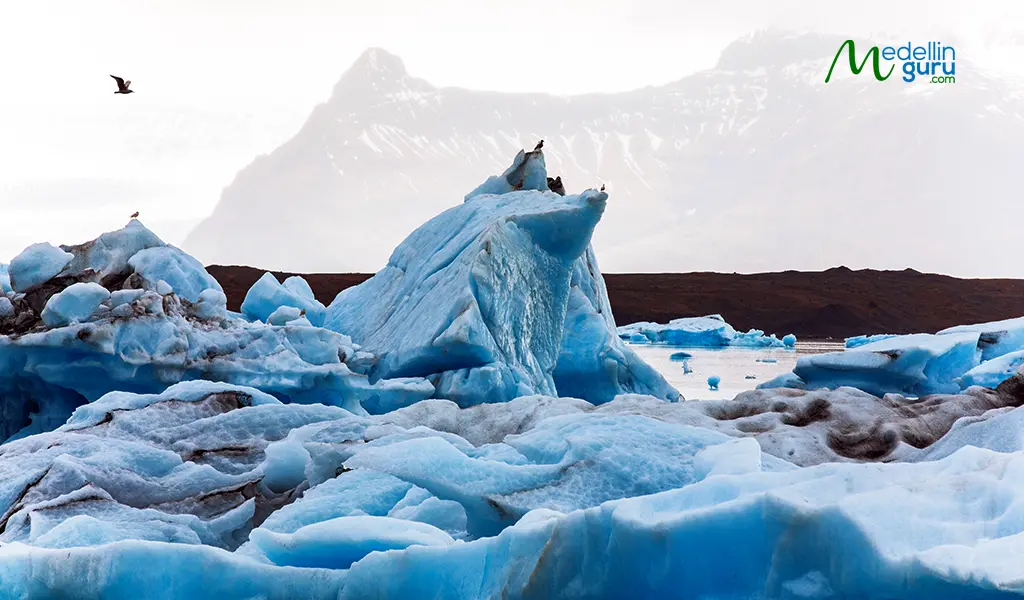
Iceland is unique. And it is, without a doubt, one of the most beautiful and amazing places on the planet, where ice and fire coexist in a tense balance. Northern lights shining over a glacier, a crystalline waterfall plunging into the void from the top of a volcanic plateau, a pearly beach with chunks of icebergs that look like diamonds. Iceland is all that. And much more.
With a surface area of 103,492 km² and barely 389,000 inhabitants—most concentrated in and around Reykjavík, its capital—Iceland is one of the least densely populated countries in the world. It is a volcanic island where only one percent of the land is arable; the rest is volcanoes, glaciers, rivers, and craters. Glaciers cover more than 10,500 km² of the territory. The highest peak is Hvannadalshnúkur, at 2,110 meters high.
The country’s history is as unique as its geography. The Althing, the Icelandic parliament, is considered one of the oldest in the world: it was founded in the year 930 in the Thingvellir valley, the same place where today tourists can walk over the visible rift between the North American and Eurasian tectonic plates. Iceland has been a republic since 1944; it is not part of the European Union but is a member of the European Economic Area and NATO.
Its language—Icelandic, a West Nordic language with Viking roots—has changed so little in a thousand years that its speakers can read medieval sagas in their original version almost without difficulty.
Tourism has become one of the pillars of the Icelandic economy in recent decades, alongside fishing and aluminum exports. Iceland receives around 2.3 million international tourists a year, an extraordinary figure for a nation of fewer than 400,000 people. That growth has an explanation: the promise of experiences that do not exist anywhere else on the planet. Northern lights, ice caves, geysers, black sand beaches, fjords. All of this, on an island that can be traveled from end to end by car.
In this guide designed by Descubre Islandia, you will find everything you need to organize your trip: where it is, how to get there, when to go to see the northern lights, what entry requirements must be met, and what routes, experiences, and excursions we offer that you cannot miss.

Descubre Islandia
Where is Iceland?
Iceland is a volcanic island in the North Atlantic Ocean, located just below the Arctic Circle. Its closest neighbors are Greenland to the northwest, Norway to the east, and the United Kingdom to the south. Reykjavík is the northernmost capital city in the world among those with more than 100,000 inhabitants.
Geographically, the country is divided into seven regions:
Capital Region
Home to the city of Reykjavík and its surroundings. It is the cultural, political, and economic center of the country.
Southern Peninsula
Famous for its lava landscapes, Keflavík International Airport, and the Blue Lagoon hot spring.
South Iceland
A route that encompasses the “Golden Circle” (Geysir, Thingvellir, and Gullfoss), the spectacular Skógafoss waterfall, black sand beaches, and large glaciers.
East Iceland
Characterized by long, deep fjords, picturesque fishing villages, and the large Hallormsstaður forest.
North Iceland
A center of intense volcanic activity and whale watching (such as in Húsavík). It is home to the famous “Diamond Circle” and the city of Akureyri.
Westfjords
One of the most remote, ancient, and rugged areas of the island. It stands out for its bird cliffs and the impressive Dynjandi waterfall.
West Iceland
This broad area consists of fjords, valleys, craters, glaciers, and volcanoes, with magnificent waterfalls, hot springs, and caves to explore.
The climate is oceanic—tempered by the Gulf Stream—with mild winters and cool summers. The average temperature in Reykjavík ranges from 0.4°C in January to 12.5°C in July. But beyond the averages, what defines the Icelandic climate is its unpredictability: it can rain, snow, and shine all in the same afternoon.
How to get to Iceland?
There are two ways to get to Iceland: by plane or by ferry. The vast majority of travelers—and all of those coming from Latin America—arrive by air at Keflavík International Airport (KEF), officially known as Leifur Eiríksson International Air Terminal, located about 50 kilometers southwest of Reykjavík.
From Latin America, there are no direct flights. The usual route is to have a layover in Europe—London, Madrid, Amsterdam, Paris, Copenhagen—and take a flight from there to Keflavík. Layovers can also be made in the United States or Canada.
The other option—more adventurous and less frequented—is the ferry. Smyril Line operates crossings from Hirtshals (Denmark), with a stop in Tórshavn (Faroe Islands) to the port of Seyðisfjörður, in the fjords of eastern Iceland. It is an ideal alternative for those traveling with their own vehicle from Europe.
Once in Iceland, transportation options are varied: renting a car (the most popular option, with total freedom of movement), campervan (which combines transport and accommodation), organized tours from Reykjavík, or public transport, which is more limited and expensive than in other parts of Europe. In winter, a 4×4 vehicle is recommended to tackle snow and ice conditions on secondary roads.
When is the best time to travel and see the northern lights?
If the main goal is to observe the northern lights, it is ideal to travel from September to April. During those months, the extreme darkness of the Icelandic winter offers the perfect conditions for the sky to light up with one of nature’s most spectacular phenomena. Auroras are solar particles that, upon interacting with the atmosphere in the Earth’s magnetic field, release energy and dye the sky green, violet, white, or red. They occur at altitudes of between 100 and 250 kilometers above the surface.
However, there are never any guarantees. That is the central point you must accept before traveling. The aurora can appear spectacularly on an October night or be completely absent in three weeks of January. The chances increase the darker and clearer the sky is, and the further away you are from the capital’s light pollution.
The Icelandic Meteorological Office (vedur.is) publishes forecasts of auroral activity on a scale of 0 to 9: with a 3 and clear skies, there are real chances of seeing the northern lights. With a 5 or more, the show can be memorable. This is a fundamental tool for aurora hunters.
The season of December, January, and February offers the longest nights—up to 20 hours of darkness—which maximizes the chances of a sighting. September and October are intermediate months, with lower prices than in peak winter and a good balance between darkness and weather conditions.
If, on the other hand, the trip aims at hiking, visiting the glaciers, and enjoying green landscapes, summer (June, July, and August) are the ideal months. The sun never completely sets—the phenomenon of the “midnight sun”—temperatures are milder, and all mountain roads are open.
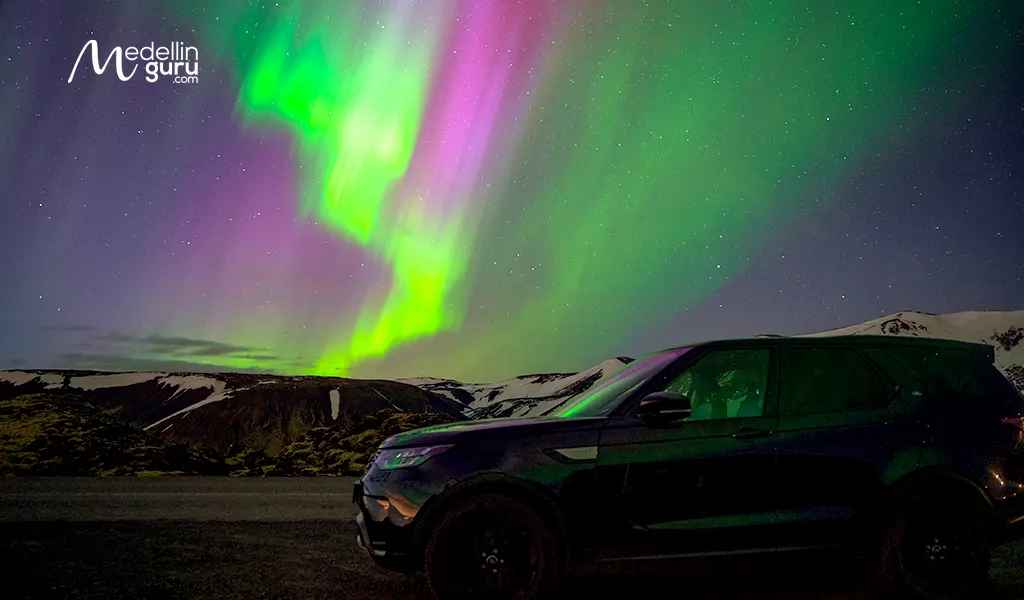
Descubre Islandia offers an exclusive four-hour tour to experience the magic of the northern lights. It departs from Reykjavík towards the best spots on the outskirts of the city to fully enjoy this unique natural phenomenon in the Icelandic sky.
It is an experience for a very small group, including comfortable transportation, an expert Spanish-speaking guide, and professional photography sessions and advice.
Descubre Islandia
What do you need to bring?
Thermal clothes
Waterproof jacket and pants
Sturdy Footwear
Gloves and a warm hat
Water bottle
Snacks
What are the entry requirements for Iceland?
Iceland is part of the Schengen Area but is not a member of the European Union. It has been a member of the European Economic Area since 1994 and NATO since 1949.
For citizens of the EU and the European Economic Area, entry is free with a national identity card or passport. For Latin American travelers, the situation varies according to nationality: passport holders from Argentina, Brazil, Chile, Colombia, Mexico, Uruguay, and several other countries in the region can enter without a visa for tourist stays of up to 90 days within a 180-day period, under the Schengen agreement. It is essential to check the updated status of agreements for your specific nationality before traveling.
Recommended documentation for entry
- Valid passport with at least 3 months of validity from the planned date of departure from the Schengen Area.
- Proof of accommodation or travel itinerary.
- Return or onward travel ticket.
- Travel insurance with medical coverage (highly recommended given the nature of the country).
- Sufficient financial funds for the stay.
The most important routes: what to see and do
The most complete itinerary to get to know Iceland in depth travels around the island in a circular direction, following the Ring Road (Route 1), and can be done in 10 to 14 days. Those with less time usually focus on the two classic southern routes (The Golden Circle and the South Coast) and some detours to the North.
Descubre Islandia designed exactly this complete tour in its 11-day and 10-night itinerary, intended to go all the way around the island with small groups and a Spanish-speaking guide throughout the journey. It includes accommodation in 3-4 star category hotels, breakfast, Wi-Fi, transport, and airport transfers, in addition to most of the excursions detailed below.
Descubre Islandia
Reykjavík and surroundings
The capital deserves at least a day and a half or two days. The Perlan museum—built on five hot water tanks—offers the best panoramic views of the city and an immersive exhibition on Icelandic nature that includes an authentic artificial ice cave. Hallgrímskirkja church, the Lutheran cathedral that dominates the Reykjavík skyline, is the architectural symbol of the city. The harbor district, with its seafood restaurants and galleries, and the local design and craft shops in the historic center complete the urban offering. Descubre Islandia’s tour kicks off precisely with a city tour of Reykjavík, a relaxation session at the Sky Lagoon hot springs overlooking the ocean, and a traditional Icelandic welcome dinner, before heading out that same night on your first northern lights hunt.
The Golden Circle
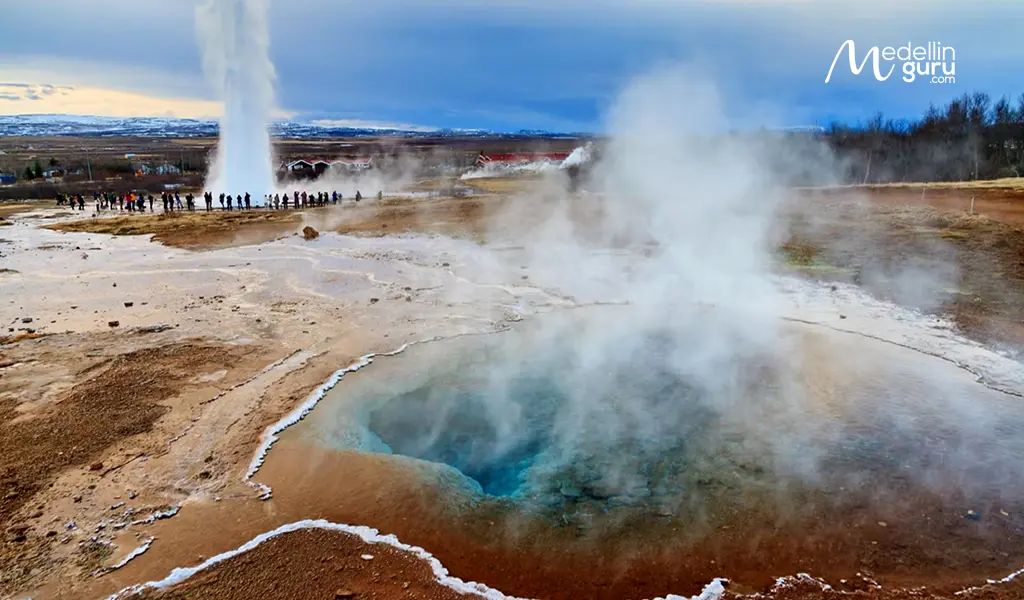
Iceland’s most popular route concentrates three of the country’s great classics into about 300 kilometers south of Reykjavík. It can be done in one long day, although two days allow you to enjoy it more calmly. Thingvellir National Park is a UNESCO World Heritage site and the founding site of the country: the Althing, the world’s first parliament, has been operating here since 930, and the visible rift between the North American and Eurasian tectonic plates also stretches out here. Walking on that geological boundary feels like a rite of passage. Geysir is the geothermal area that gave the phenomenon its name: the Strokkur geyser erupts every five to ten minutes, shooting columns of boiling water up to 30 meters high. The spectacle can be seen from very close. Gullfoss waterfall is, for many, the most impressive in Europe. The Hvítá river falls in two tiered drops into a 32-meter-deep canyon, generating a permanent cloud of mist and rainbows. The Kerið crater, a volcanic caldera with red walls and an emerald green inner lake, usually closes the Golden Circle day. Descubre Islandia includes this complete tour in its itinerary, with lunch at the Fridheimar geothermal farm, famous for its tomato greenhouses.
Snæfellsnes, Iceland in miniature
From Reykjavík, Descubre Islandia’s itinerary continues west to the Snæfellsnes peninsula, known as “Iceland in miniature” because it concentrates black lava, beaches, glaciers, and emblematic mountains in just a few kilometers. The black church of Búðakirkja, the village of Arnarstapi, the Lóndrangar cliffs, and the iconic Mount Kirkjufell—one of the most photographed in the country—are part of this stretch.
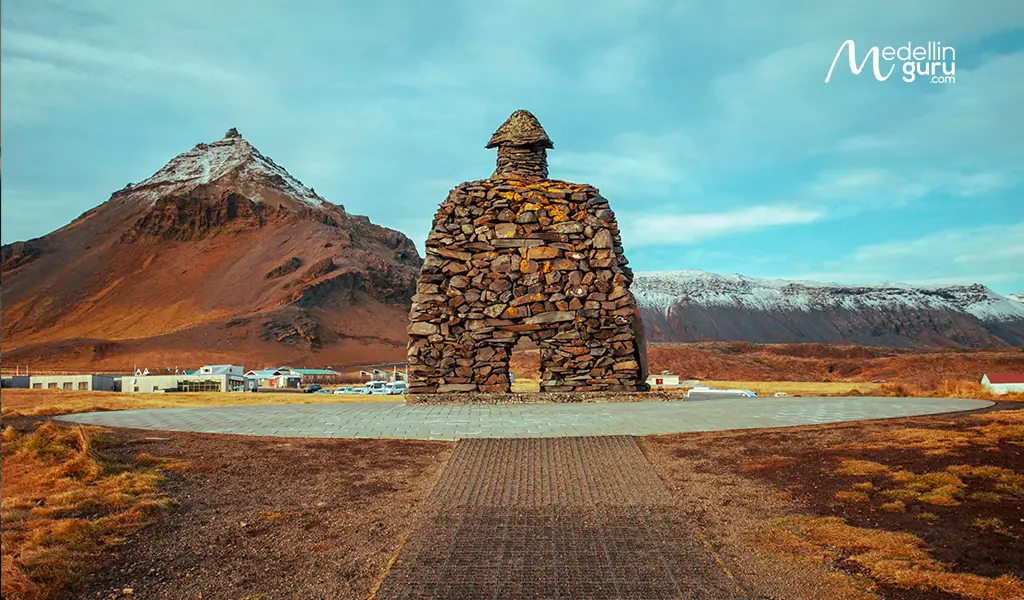
Heading north: Akureyri and Lake Mývatn
From Snæfellsnes, the route continues north. Along the way, the Glaumbær museum preserves a group of traditional 18th-century Icelandic turf houses, a direct window into the daily life of pre-industrial Iceland. Akureyri, Iceland’s second city with just over 20,000 inhabitants, is the perfect base for this area and the starting point for whale watching excursions. Lake Mývatn and its surroundings are an area of intense geothermal activity: the Námafjall area with its fumaroles and boiling mud pools, the Dimmuborgir rock formations—lava structures that look like ruins from another world—and the Hverfjall crater complete an experience that combines geology and adventure. The Goðafoss waterfall, according to tradition, was the place where statues of the Norse gods were thrown into the water when Iceland adopted Christianity in the year 1000. Descubre Islandia adds to this leg a stop at Forest Lagoon, a thermal spa hidden in a birch forest near Akureyri, and closes the day with the Mývatn Nature Baths, overlooking the lake.
Towards the east: Dettifoss and the fjords
Dettifoss is the most powerful waterfall in Europe: 200 meters wide and a 44-meter drop, with a flow rate that can reach 1,500 cubic meters per second. Continuing east, the less-visited Iceland reveals itself in the East Fjords: wild landscapes, rugged mountains, and small fishing villages like Egilsstaðir. Descubre Islandia includes in this section a hike to the Stuðlagil canyon, famous for its basalt columns, before delving into the fjord route.
The southeast: Vestrahorn, ice caves, and Jökulsárlón
The East offers some of the most spectacular natural jewels in the country. Vestrahorn is a dramatic mountain by the sea, with a reconstructed Viking village that served as a filming location for series like The Witcher. The Jökulsárlón glacier lagoon is one of Iceland’s great icons: deep blue blocks of ice float silently on a lake where the glacier and the ocean meet. Diamond Beach, just a few meters away, is the result of those same blocks of ice when they reach the seashore: on the black sand, the fragments of translucent ice shine like jewels. Descubre Islandia incorporates in this stage a guided excursion to the Vatnajökull ice caves (available in the October to April season), in addition to a visit to the homonymous National Park, which protects the largest glacier in Europe, with more than 7,900 km².
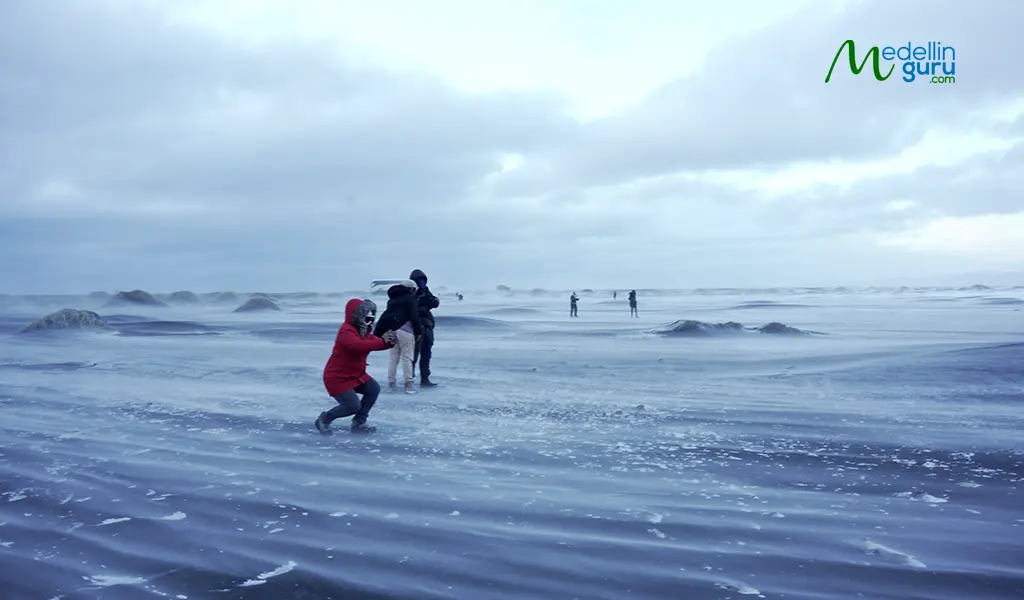
Glaciers and southern beaches, heading to Vík
Heading south, Svínafellsjökull is an imposing and accessible glacier, ideal for glacier hiking and ice climbing on frozen waterfalls. Fjaðrárgljúfur canyon, famous for its scenic beauty, and the picturesque village of Kirkjubæjarklaustur are the stops prior to Vík, with its colorful houses at the foot of volcanic mountains. Reynisfjara’s black sand beach, a few kilometers away, and its basalt columns are among the great attractions of the region, along with the Dyrhólaey cliffs.
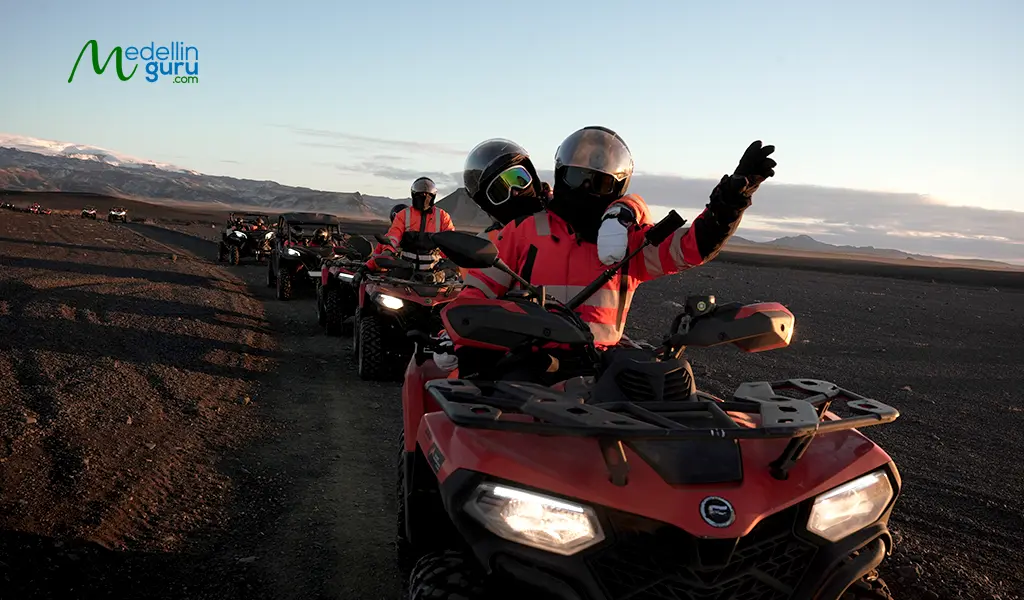
South Coast: waterfalls and closing the circle
The last major stretch of the journey brings together some of the most beautiful waterfalls in the country: Skógafoss, which falls from a height of 65 meters; Seljalandsfoss, the one you can walk behind; and the hidden Gljúfrabúi, between rocks and sea spray. Descubre Islandia adds to this stage a buggy tour along Vík’s black beach for those looking for an extra dose of adrenaline, before returning to Reykjavík. The circle closes with a visit to the Blue Lagoon, the most famous hot spring in the world, 20 minutes from Keflavík airport—the ideal finishing touch before returning or for your last free afternoon in the capital.
Discover the complete 11-day itinerary and go all the way around the island with Descubre Islandia. Prefer to put together your own tour? Choose between Descubre Islandia’s individual and group experiences—Golden Circle, South Coast, Snæfellsnes, and more—and add only the ones that interest you most.
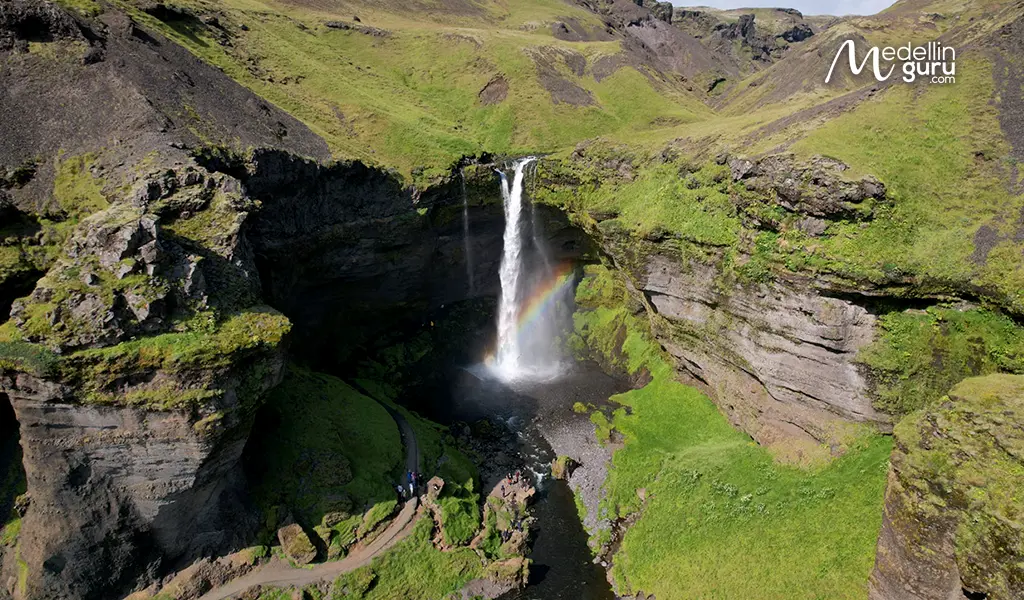
Why is Iceland worth visiting?
Nowhere else in the world will you be able to see glaciers, geysers, monumental waterfalls, northern lights, and black sand beaches on the same trip. And do it by car, with total freedom, in less than two weeks. Nature here is not just a backdrop: it is the focal point of the entire experience. Add to that a solid tourist infrastructure, a safe country, card payments even in the farthest reaches of the Ring Road, and, for Latin Americans from several countries, visa-free entry. A trip to Iceland, above all things, is unique and unforgettable.
Ready to live the experience?
At Descubre Islandia, we are the result of the experience of Colombian-Icelandic experts who have lived, explored, and vibrated with the magic of this island firsthand. We know the silence of its glaciers, the power of its volcanoes, and the luxury of its hospitality.
We are not just a travel agency; we are your local hosts. We design your custom experience, with the Latin warmth and precision that this destination demands.
Descubre Islandia
Medellin Guru's comprehensive Colombian culture series
In Medellin Guru, we love Colombia, and we usually write many blogs about Colombian culture, places to visit, and other tips for all expats to have a reliable guide and valuable and relevant information about Colombia. Read our blogs about Colombian Culture here:
- Top Tourist Attractions in Colombia: Top Things to Do
- Top Things to Do in Medellín and Nearby: Top Tourist Attractions
- How to be an Expat in Colombia: 12 Tips to be a Successful Expat
- Top Things to Do in Cali and Nearby: Top Tourist Attractions
- Celebrating July 20th: Colombia Independence Day
- Norte de Santander: 5 Escapes for a Weekend Adventure
- Unlock Ipiales in 24 Hours: Your Essential Adventure Blueprint!
- Pasto: Discover the wonders of the Surprise City
- Top Popular Colombian Drinks to Try When You Visit Colombia
- Villa de Leyva: A Colonial Gem in the Colombian Andes
- Traditional Colombian Food Dishes You Must Try in Colombia
- Popular Colombian Desserts You Must Try While in Colombia
- Exotic Tropical Fruits of Colombia a Fruit Lovers Paradise
- Popular Colombian Soups to Try When You Visit Colombia
- Día de las Velitas: Day of Candles Tradition in Colombia on December 7
- Things in Colombia That May Be Strange for Foreigners
- Things Colombians Do That Foreigners May Find Weird
- Popayán: A Well-Preserved Colonial Gem in Colombia Worth Visiting
- Tejo: A Colombian Game That Rewards You for Explosions
- Feria de las Flores: History of the Flower Festival in Medellín Colombia
- Nevado del Cocuy: Everything You Need to Know Before Visiting
- Beyond Medellín: 7 Magical Best Towns to Spend Christmas in Colombia
- Día de las Velitas: Day of Candles Tradition in Colombia on December 7
- Novena de Aguinaldos: A Guide to Participating in 9-Day Ritual
- Paisa Dictionary: Medellín Slang Vocabulary for Expats and Travelers
- Florecer: Orquideas, Naturaleza y Tradiciones
- 15 Places to Visit in Cartagena: Prepared to be Amazed by the Final Destination
- Top 20 Tourist Attractions in Colombia: Best Places to Visit and Things to Do
- Recommended Tourist Itinerary for a Day in Medellín
Other things to see and do in Colombia
- Caño Cristales – the most beautiful river in Colombia, which has also been called the most beautiful river in the world by some people.
- Carnival in Barranquilla – the second largest carnival in the world.
- Cartagena – Oozing history, romance and sun-drenched beaches, the allure of historical Cartagena is hard to resist.
- Ciudad Perdida – the site of an ancient city in Colombia that is older than Machu Picchu in Peru.
- Colombia’s Pacific coast – often overlooked by tourists visiting Colombia but offering untamed nature and undiscovered beauty that is off the beaten path for most foreign tourists.
- Desierto de la Tatacoa – the second largest arid zone in Colombia is Tatacoa Desert, which has surreal desert landscapes and some of the best stargazing in Colombia.
- Guatapé – a picturesque pueblo near Medellín known for its huge rock and lake. And it’s likely the most visited pueblo in Colombia by foreigners.
- La Guajira Peninsula – one of the most visually stunning places in South America, which is located on the northern tip of Colombia where the desert meets the sea.
- Las Lajas Sanctuary – the most beautiful church in Colombia, which has also been called the most beautiful church in the world.
- Medellín’s Christmas lights – Medellín’s annual world-class Christmas lights known as Alumbrados Navideños.
- Feria de Las Flores Medellin – Medellín’s world-famous flower festival each year.
- Parque Nacional Natural Los Nevados – a popular national park in Colombia located in the heart of the Colombian coffee region.
- Parque Tayrona – known for its beautiful beaches and the world’s highest coastal mountain range.
- Popayán – a colonial gem in Colombia best known for its white buildings and churches, it’s a city off the beaten path for foreign tourists but is definitely worth visiting.
- Rio Claro Nature Reserve – located about three hours from Medellín, Rio Claro is the perfect place to unplug from hectic daily life and enjoy a picturesque crystal-clear river, canyon and tropical rainforest.
- Salento and the Cocora Valley – Salento is a picturesque pueblo in Colombia’s coffee region and the nearby Cocora Valley is one of the most striking landscapes found in Colombia.
- San Agustín Archaeological Park – the largest group of pre-Columbian monuments and megalithic statues in South America and is a UNESCO World Heritage Site.
- San Andrés – Colombia’s Caribbean island which is a UNESCO World Biosphere Reserve featuring many beaches, islets and coral reefs that are filled with flora and fauna.
- San Gil – Colombia’s adventure capital that is full of things to do including white water rafting, paragliding, caving, rappelling, hiking and much more.
- San Jose del Guaviare – a hidden gem and eco-tourism location off the beaten path and offering wildlife watching, jungle trekking and delving into Colombia’s prehistoric past.
The bottom line: Iceland is a once-in-a-lifetime journey
Visiting Iceland is more than just a vacation; it is an immersive expedition into one of the Earth’s most dynamic and untamed landscapes. Whether you are chasing the magical Northern Lights across a winter sky, standing in awe before roaring waterfalls, or soaking in geothermal hot springs after a day on the Ring Road, the island promises experiences that stay with you forever. With proper planning, the right seasonal expectations, and expert local support, your Icelandic adventure will be seamless, safe, and truly unforgettable.
- The advantage of an expert guide : Until now, one of the main problems many foreigners faced during the fingerprinting process was geographical limitation, with only a couple of cities having specialized machines to complete this step (Medellín and Bogotá). expatgroup.co seeks to eliminate this barrier by expanding its options and coverage to Barranquilla.
- Flexible ways to explore the island: Whether you want to drive the Ring Road in 10–14 days, focus on iconic routes like the Golden Circle and South Coast, or join an exclusive guided tour, there are tailored options for every travel style.
- Comprehensive service and local support: Fingerprinting or booking an excursion is only the first step of a great experience. Descubre Islandia provides end-to-end hosting, Spanish-speaking guides, transfers, accommodation, and professional photography assistance, ensuring a safe, smooth, and unforgettable adventure
Don’t let uncertain planning or logistical challenges slow down your dream trip. Start crafting your dream itinerary today and get ready to discover the land of fire and ice!
Medellin Guru Social media
Be part of our community. Find out about news, participate in events and enjoy the best of the city.